
Course

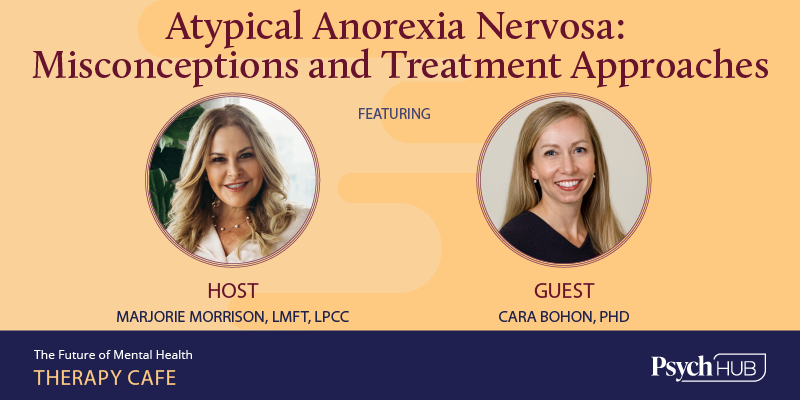
Therapy Cafe (Video Version) - Atypical Anorexia Nervosa: Misconceptions and Treatment Approaches

Atypical anorexia became a subtype of other specified feeding and eating disorders (OSFED) in 2013, leading to many common misconceptions about the severity of the illness and its best treatment approach. In this course, Dr. Cara Bohon will explore…

1 CE credits1 hrIntroductoryBehavioral Health Provider Courses
Get Started

About this course

Atypical anorexia nervosa (AAN) is a sub-diagnosis for patients who meet all the criteria for anorexia, except for being underweight. However, the term “atypical” is a glaring misnomer, as AAN affects up to 4.9% of people during their lifetime, whereas anorexia nervosa (AN) affects about 0.6%. Atypical anorexia became a subtype of other specified feeding and eating disorders (OSFED) in 2013, leading to many common misconceptions about the severity of the illness and its best treatment approach. In this course, Dr. Cara Bohon, licensed clinical psychologist, Clinical Associate Professor, Department of Psychiatry and Behavioral Sciences, Stanford University, and Senior Vice President of Clinical Programs at Equip, will explore these diagnostic labels, assess the severity and treatment trajectory for patients with AAN compared to AN, and propose considerations for future diagnostic clarifications.


1 hour CE. Recorded video format (non-interactive)

This course is the video version of this Therapy Cafe podcast episode. If you would like to listen to the audio version, you can search for the audio version of this title in the course catalog. 

Course details

ESTIMATED COURSE LENGTH: 1 hour 

CE CREDITS:1 hour continuing education/contact hours for social workers, psychologists, counselors, and marriage and family therapists

TARGET AUDIENCE: Mental Health Practitioners

LEVEL OF INSTRUCTION: Introductory 

PREREQUISITE(S): None

INSTRUCTIONAL METHOD: Recorded video format (non-interactive)

ACCESSIBILITY ACCOMMODATIONS: Closed captioning. To request further accessibility accommodations, please email support@psychhub.com.

COMPLETION REQUIREMENTS: To obtain your CE certificate, learners must take the pre-test, watch the full course, complete a participant evaluation, and obtain a score of 80% or higher on a post-test. Learners are expected to complete the quiz within 3 attempts. If unable to do so, the learner will need to re-review the course segments.

FINANCIAL/COMMERCIAL SUPPORT STATEMENT: This course has no commercial support.

CONFLICT OF INTEREST:  This course has no outside commercial support. Dr. Cara Bohon has a relevant disclosure noted in the Continuing Education Information section of this course. Psych Hub's conflict of interest statement is found in the footer of the training center.

GRIEVANCE AND REFUND POLICIES: Grievance and refund policies are found in the footer of the training center.

PARTICIPATION COSTS:  The cost to participate in this CE activity is included in the subscription registration fee.

COURSE CREATION DATE: 9/26/2024

What you'll learn

By the end of this course, participants will be able to:

  1. Explain the differences (or lack thereof) between atypical anorexia nervosa (AAN) and anorexia nervosa 

  2. Recognize the severity of AAN and the urgency for treatment

  3. Identify necessary components for treatments for AAN


Course outline


  • Introduction to Eating Disorders

    • Overview of DSM-5 Eating Disorder Classifications
    • Characteristics of Anorexia Nervosa (AN)
  • Atypical Anorexia Nervosa (AAN)

    • Defining AAN: Similarities and Differences with AN
    • Historical Background of AAN
  • Diagnostic Clarifications and Clinical Presentation

    • Diagnostic Challenges with AAN
    • Overcoming Barriers to Diagnosis
  • Treatment Approaches for Atypical Anorexia Nervosa

    • Treatment Urgency and Severity of AAN
    • Components of Effective Treatment
    • Examples of Successful Treatment
  • Therapeutic Considerations for Practitioners

    • Challenges for Therapists Treating AAN
    • Best Practices for Assessing and Discussing Eating Disorders
  • Future Considerations and Ongoing Learning

    • Diagnostic Considerations for the Future
    • Resources for Therapists

Accreditation

  • Certificate of Completion
  • American Psychological Association (APA) (APA)
  • Association of Social Work Boards (ASWB) (ASWB)
  • California Association of Marriage and Family Therapists (CAMFT) (CAMFT)
  • National Board for Certified Counselors (NBCC) (NBCC)
  • New York State Education Department - Licensed Mental Health Counselors (NYSED-LMHC) (NYSED-LMHC)
  • New York State Education Department - Marriage & Family Therapists (NYSED-MFT) (NYSED-MFT)
  • New York State Education Department - Psychology (NYSED-PSY) (NYSED-PSY)
  • New York State Education Department's State Board for Social Work (NYSED-SW) (NYSED-SW)
  • Florida Board of Clinical Social Work, Marriage and Family Therapy and Mental Health Counseling (FLB)
  • Ohio Counselor, Social Worker and Marriage and Family Therapist Board (OH)

Instructors

  • Cara Bohon, PhD
  • Marjorie Morrison, LMFT, LPCC

Keep learning with Psych Hub.

Take courses, earn CE, and save the resources you use most.